

Yamaha - A-S501 Integrated Amplifier
Yamaha - A-S501 Integrated Amplifier
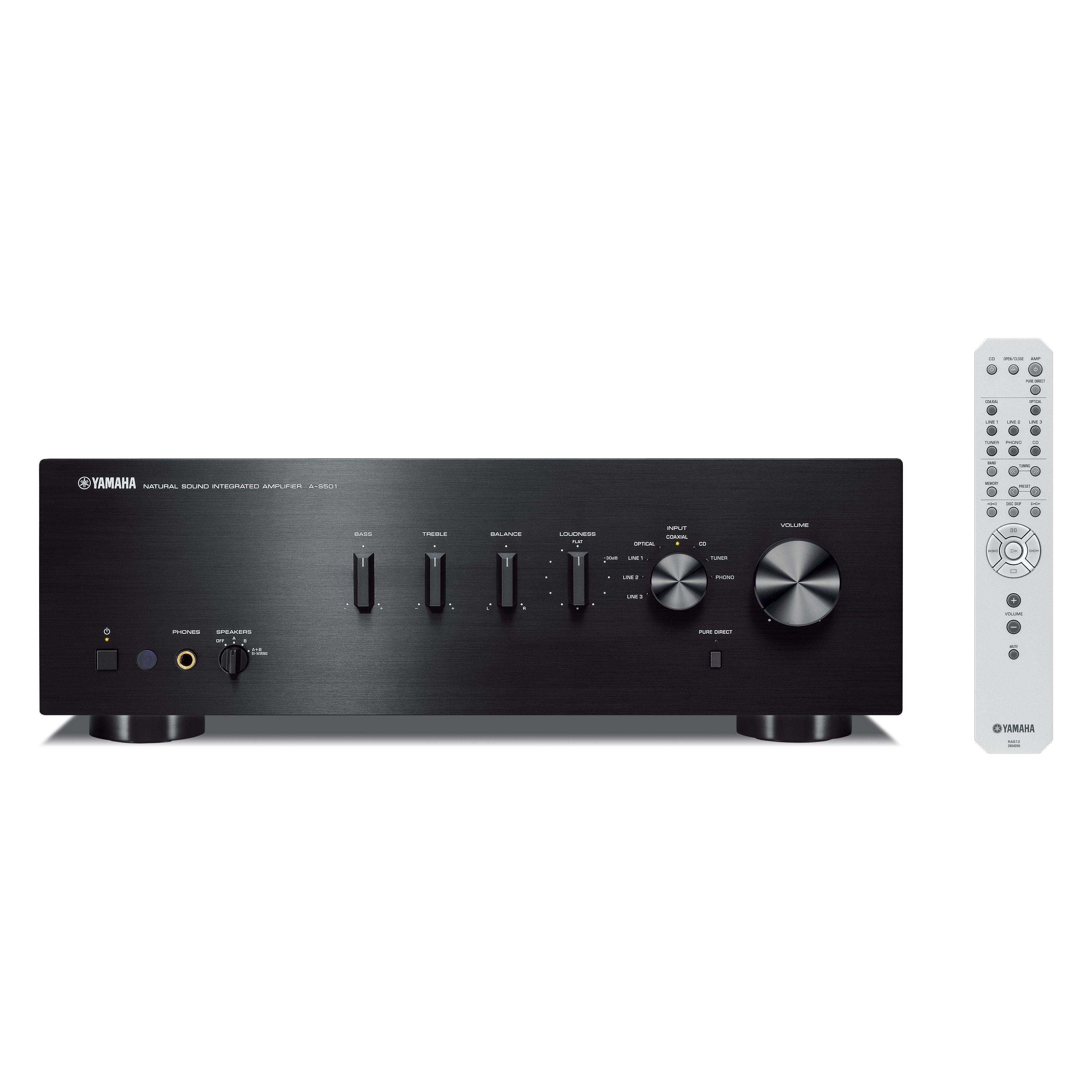
A straight power step up from the A-S301 — 85 watts a side instead of 60, rated the same honest way — with the same ToP-ART layout, moving-magnet phono stage and digital inputs.
ToP-ART, Yamaha’s Total Purity Audio Reproduction Technology, is a layout philosophy rather than a circuit: the left and right channels are laid out as mirror images and the signal takes the shortest, straightest route from input to output, on the reasoning that a shorter path picks up less noise and adds less distortion. The ART (Anti-Resonance and Tough) Base is the mechanical half of the same idea — a stiffened bottom chassis with a solid centre bar that damps vibration before it reaches the circuit boards. Both are real, named engineering choices; Yamaha publishes no measurement isolating what either contributes.
The A-S501 and the A-S301 below it are the same amplifier in concept. What you gain here is output: 85 watts a channel into 8 ohms against 60, a larger transformer and chassis (22.7 lb against 19.8), higher dynamic power into every load, and a stronger headphone output. Both figures are rated across the full audio band at 0.019% distortion, so this is a genuinely comparable step and not a specification trick. No feature appears here that the A-S301 lacks — phono is still moving-magnet only, there is still no USB and no DAC branding, and there are still no level meters.
Pure Direct routes the signal by the shortest internal path available, bypassing the buffer amplifier and the tone, loudness and balance controls. The continuously variable loudness control does the opposite job when you want it: because hearing loses sensitivity at the frequency extremes as level drops, it dials in a variable amount of bass and treble lift as you turn down, rather than the single fixed curve a simple loudness switch gives you.
One caution on the damping figure below: Yamaha’s web page and Yamaha’s own owner’s manual do not agree, and because the manual shares one table across three models we cannot tell which is the typo. We quote both rather than pick the flattering one.
Features
- 85 W + 85 W into 8 ohms, 20 Hz – 20 kHz at 0.019% THD
- 100 W + 100 W into 6 ohms
- ToP-ART symmetrical layout with ART Base anti-resonance bottom chassis
- Moving-magnet phono input
- Optical and coaxial digital inputs, PCM up to 192 kHz
- Pure Direct mode and continuously variable loudness control
- Bass, treble and balance controls
- Subwoofer output
- Two pairs of gold-plated binding posts with A / B / A+B bi-wiring
- DC OUT for the optional Yamaha YBA-11 Bluetooth adapter
- Available in black or silver
Specifications
- Type: Two-channel integrated amplifier
- Rated power output (8 ohms): 85 W + 85 W, 20 Hz – 20 kHz, 0.019% THD
- Rated power output (6 ohms): 100 W + 100 W (owner’s manual). Yamaha publishes no distortion or bandwidth condition with this figure, unlike the 8-ohm rating above
- Dynamic power (IHF): 130 W into 8 ohms, 150 W into 6 ohms, 185 W into 4 ohms, 220 W into 2 ohms, per channel
- Frequency response: 10 Hz – 100 kHz, ±1.0 dB (Pure Direct); 20 Hz – 20 kHz, 0 ±0.5 dB (CD input)
- Total harmonic distortion: 0.019% or less, 20 Hz – 20 kHz. Yamaha’s manual states the reference power as 45 W into 8 ohms; the US specification page states 50 W into 8 ohms. Both are Yamaha figures and we report both
- Signal-to-noise ratio: 99 dB or more (CD, Pure Direct on, IHF-A)
- Damping factor: Yamaha’s US specification page states 240; the owner’s manual attributes 210 to this model and 240 to the A-S701. The manual carries all three entry models in one shared table, so we cannot resolve which is correct and quote both
- Phono stage: Moving magnet only, 3.0 mV / 47 kilohms
- RIAA deviation: Not published
- Built-in DAC: No. This model has optical and coaxial digital inputs, so a converter is obviously present, but Yamaha names no chip and does not market the amplifier as having a DAC — unlike the A-S801, which is the only integrated in the range with a Yamaha-branded, chip-named USB DAC. There is no USB input and no DSD support here.
- Digital inputs: Optical ×1, coaxial ×1. PCM only, up to 192 / 176.4 / 96 / 88.2 / 48 / 44.1 / 32 kHz
- Analogue inputs: PHONO (MM), CD, LINE 1, LINE 2
- Outputs: Speakers A and B, subwoofer out, REC OUT, DC OUT, headphones
- Preamp out / main in: Not confirmed. The terminal list in Yamaha’s owner’s manual for this model does not show MAIN IN or PRE OUT jacks, and Yamaha does not state their absence either. We report this as a gap rather than guess.
- Balanced XLR input: No
- Headphone output: 430 mV / 470 ohms (CD input, 1 kHz, 200 mV, 8 ohms)
- Tone controls: Bass and treble. Balance control fitted
- Loudness: Continuously variable
- Pure Direct: Yes
- Level meters: No
- Subwoofer output: Yes
- Speaker terminals: Two pairs, gold-plated binding posts, A / B / A+B bi-wiring
- Dimensions (W×H×D): 17-1/8″ × 6″ × 15-1/4″ (435 × 151 × 387 mm)
- Weight: 22.7 lb (10.3 kg)
- Power consumption: 240 W; 0.5 W standby
- Finishes: Black and Silver (A-S501BL and A-S501SL)
- Country of manufacture: Not published. Yamaha prints no country-of-manufacture statement on this model’s US product pages, specification tables or owner’s manual. The only geographic reference in Yamaha’s own documentation is the corporate head-office address in Hamamatsu, Japan, which is a company address and not a manufacturing statement. Third-party retailers and reviewers often assert “made in Japan” for this model — Yamaha does not.
- Warranty: Two years, parts and labour, under Yamaha Corporation of America’s general A/V Products limited warranty, which is the document Yamaha’s warranty index links for this class of product. Yamaha states that warranty registration is not required for coverage. The warranty is enforceable only by the original purchaser and is not transferable. The owner pays shipping to the service centre; Yamaha covers return shipping on a covered repair.