

Musical Fidelity - M5si Integrated Amplifier
Musical Fidelity - M5si Integrated Amplifier
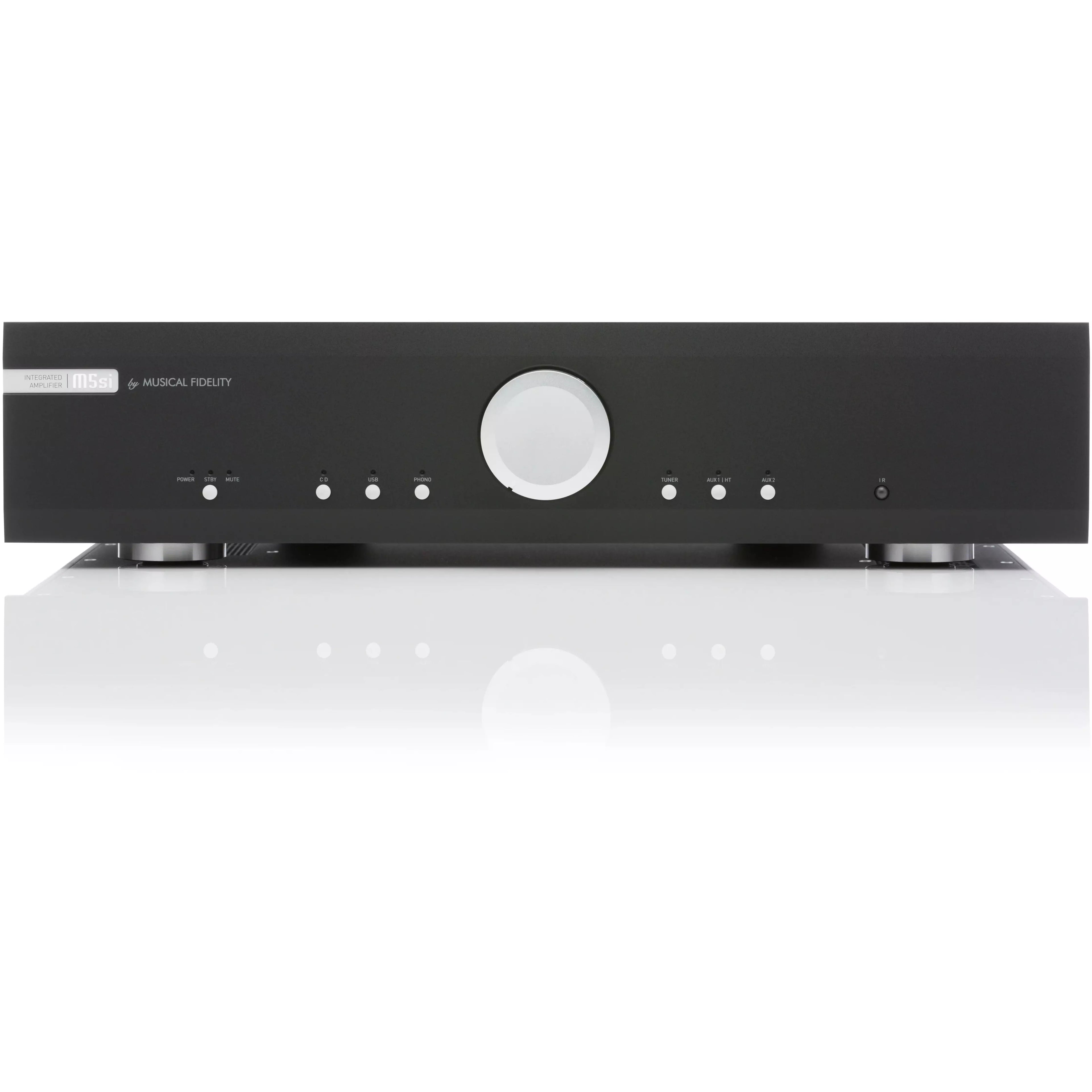
150 watts per channel from two independent monoblocs and a separate preamplifier on a single board, with a moving magnet phono stage and asynchronous USB built in.
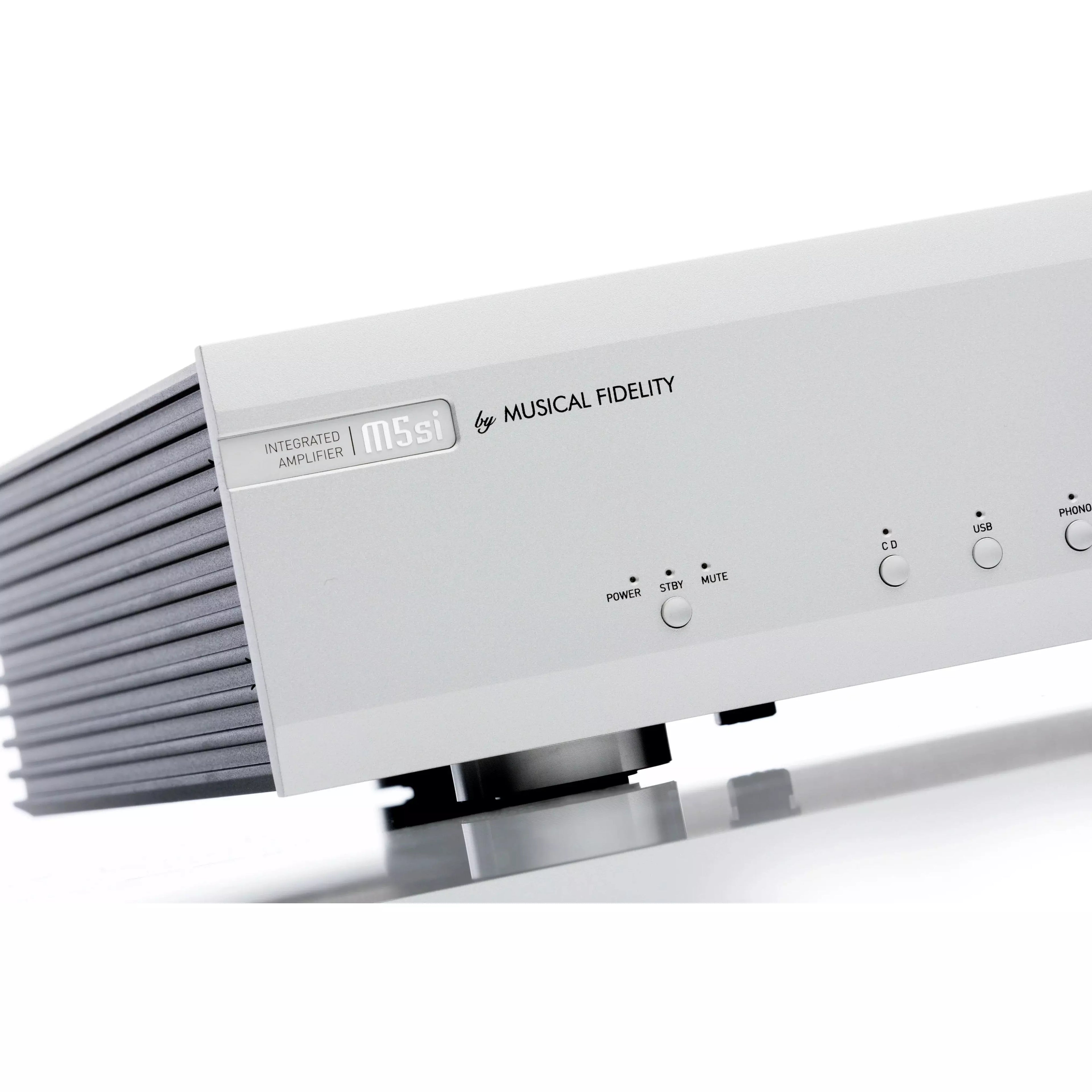
Musical Fidelity’s own description of the M5si’s architecture is worth taking literally: internally it is configured as two independent monobloc power amplifiers with a separate preamplifier, all mounted on one circuit board. It delivers 150 watts per channel into 8 ohms with distortion below 0.010% across the audio band, better than 100dB of A-weighted signal-to-noise, and a frequency response held to +0/−0.1dB from 10Hz to 20kHz.
The M5si was developed after the flagship Nu-Vista 800, and Musical Fidelity says some of that model’s subtler PCB layout solutions found their way into this amplifier. The chronology checks out — the Nu-Vista 800 came first and has since been discontinued, while the M5si remains a current catalogue product. Musical Fidelity also describes the M5si’s technical performance as close to that of the M6si; we would rather you saw the numbers and judged for yourself, because the two models differ materially on paper (150W against 220W, 0.010% against 0.007% distortion, and a damping factor of 36 against 180).
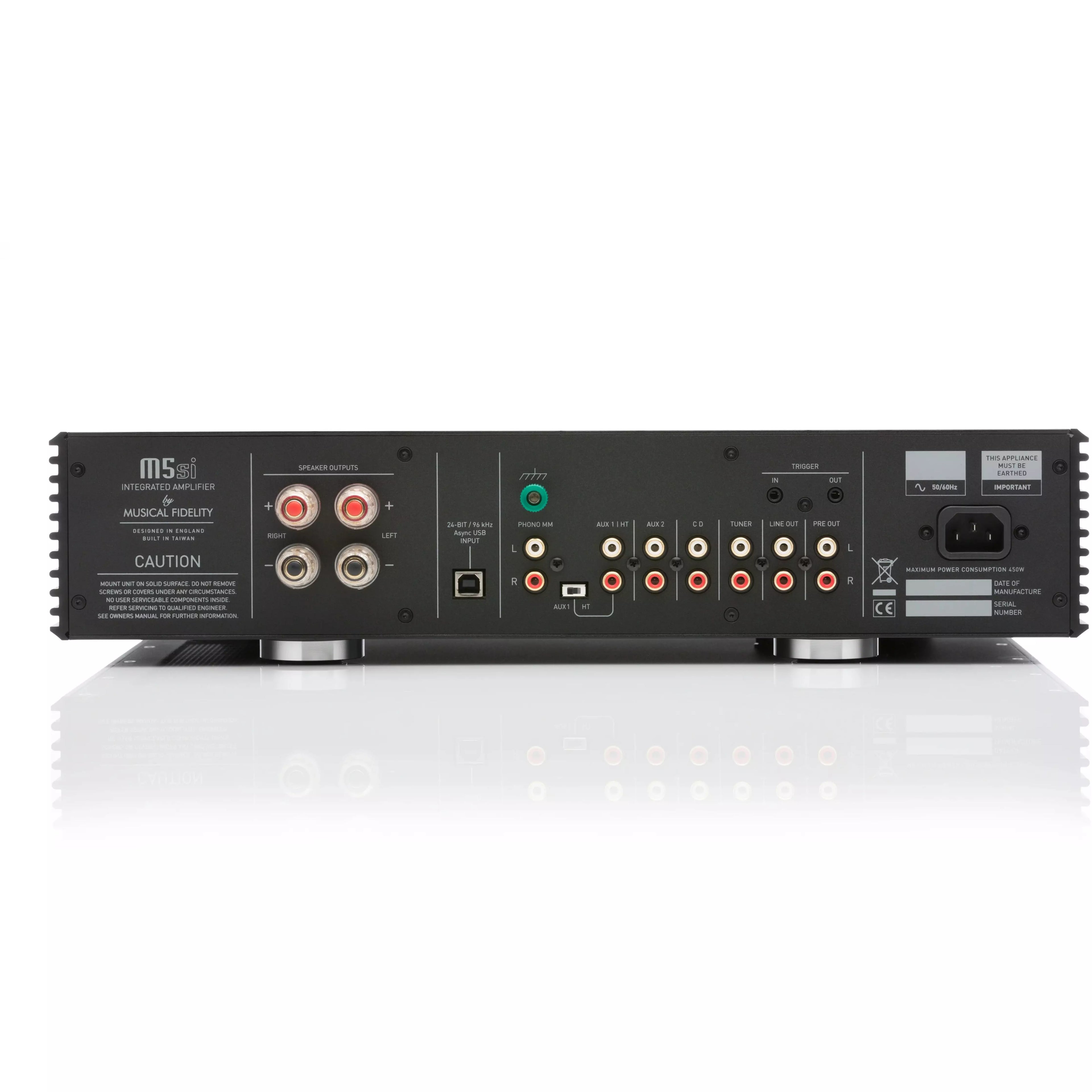
Connectivity is deliberately straightforward. Four line-level RCA inputs, a moving magnet phono stage, and a single asynchronous USB type B input accepting up to 24-bit/96kHz — that USB socket is the amplifier’s only digital input, as there is no coaxial or optical connection. The phono stage is MM only, and Musical Fidelity notes it suits cartridges putting out 1.5mV or more, which takes in high-output moving coils but not low-output MC designs. If you run a low-output moving coil, you want the M6si or an outboard stage.
Both fixed line-level and variable preamp outputs are fitted, the variable pair intended for bi-amping or adding a subwoofer, along with 12V trigger in and out. There is one set of speaker terminals — Musical Fidelity’s “2 pairs” means one left pair and one right pair, not A/B switching — and no headphone socket. A universal infrared remote is supplied that handles volume, input selection and mute, and will also drive a matching Musical Fidelity CD player.
Features
- 150 watts per channel into 8 ohms, configured internally as two independent monoblocs with a separate preamplifier
- Developed after the flagship Nu-Vista 800 and sharing some of its PCB layout solutions
- Moving magnet phono stage, suitable for cartridges of 1.5mV output or more including high-output moving coils
- Asynchronous USB type B input accepting up to 24-bit/96kHz
- Four line-level RCA inputs
- Fixed line-level output plus a variable preamp output for bi-amping or a subwoofer
- 12V trigger in and out
- Universal infrared remote supplied — volume, input select, mute, and transport control for a matching Musical Fidelity CD player
- Distortion below 0.010% and better than 100dB A-weighted signal-to-noise
Specifications
- Type: Stereo integrated amplifier
- Power Output: 150 watts per channel into 8 ohms
- THD + Noise: <0.010% typical, 20Hz – 20kHz
- Signal-to-Noise Ratio: >100dB A-weighted
- Frequency Response: +0, −0.1dB, 10Hz – 20kHz
- Output Voltage: 35V RMS, 20Hz – 20kHz; onset of clipping at 99V peak to peak
- Output Current: 62 amps peak to peak — see note below
- Damping Factor: 36 (published in the owner’s manual, absent from the website specification table)
- Output Devices: 2 pairs per channel
- Line Input Impedance: 40k Ω
- Inputs: 4 x line level RCA; 1 x USB type B (asynchronous, up to 24-bit/96kHz); 1 x MM phono; trigger in
- Phono Type: Moving magnet only. Musical Fidelity states it suits cartridges giving 1.5mV or more, which includes high-output moving coil types. There is no MC setting
- Phono Sensitivity: 3mV nominal (MM)
- Phono Input Impedance: 50k Ω. Note this is Musical Fidelity’s own figure, published consistently on the product page and in the manual. The industry standard for MM loading is 47k Ω, so 50k is non-standard, but the audible consequence is negligible and we have reproduced it as published rather than corrected it
- Phono Signal-to-Noise Ratio: >70dB A-weighted
- Phono RIAA Accuracy: RIAA/IEC within ±0.5dB, 20Hz – 20kHz
- Phono Grounding: 4mm banana post to chassis earth
- Digital Inputs: USB type B only — there is no coaxial or optical input
- Outputs: Trigger out; 1 pair fixed line level RCA; 1 pair variable preamp RCA
- Speaker Outputs: One stereo set on 4mm banana plug / binding posts (one left pair, one right pair). There is no A/B speaker switching
- Headphone Output: None
- Remote Control: Supplied. M5s series universal infrared handset covering volume, input selection (CD, USB, PHONO, TUNER, AUX1/HT, AUX2) and mute, plus transport functions for a matching Musical Fidelity CD player. Two LR03/AAA alkaline batteries supplied
- Mains Voltages: 115/230VAC 50/60Hz, factory pre-set; 100VAC 50/60Hz available
- Power Consumption: <0.5W standby; 450 watts maximum
- Supplied Accessories: 10-amp IEC mains lead, remote control, 2 x AAA batteries
- Dimensions (W x H x D): 440 x 100 x 405 mm (17-1/3″ x 4″ x 16″), height including feet, depth including terminals
- Weight: 14.6 kg (32 lb) unpacked; 18.8 kg (41.5 lb) in the shipping carton
- Warranty: Two years, administered by the local national distributor — Harmonia Distribution has handled Musical Fidelity in the United States since 15 November 2025. Cover is for the original owner only, is non-transferable, and requires the original sales invoice as proof of purchase date. Older Musical Fidelity literature quoting a five-year term with separate categories for disc players and servers is obsolete
- Country of Manufacture: Not published. Musical Fidelity was founded in London in 1982 and has been owned since 2018 by Audio Tuning Vertriebs GmbH of Austria, the parent of Pro-Ject. The company states that its products are designed and voiced in the UK and continental Europe, which is a design statement rather than a manufacturing one, and it publishes no country of manufacture for this model
- Not Published: Power output into 4 ohms; channel separation; line input sensitivity (only the 40k Ω input impedance is given); the USB receiver or DAC chipset; slew rate; output impedance; phono overload margin; phono distortion
- Note: Musical Fidelity’s manual credits the 150W M5si with 62 amps peak-to-peak output current but the more powerful 220W M6si with only 45 amps. The lower-powered amplifier claiming substantially more peak current than its bigger sibling is not credible, and one of the two figures appears to be an error in Musical Fidelity’s documentation. We reproduce the published figure but would not use it comparatively